

From Server Racks to Desktop AI: 50 Years of Mini PC Evolution
Source: DIY ZOL
When Jensen Huang took the stage in San Jose, California — at GTC on March 18, 2025 (PT) — NVIDIA unveiled the DGX™ personal AI supercomputer built on the NVIDIA Grace Blackwell platform. This desktop-class AI powerhouse, no larger than a mini PC yet capable of training trillion-parameter models, showcased the ultimate form of the mini-computer.
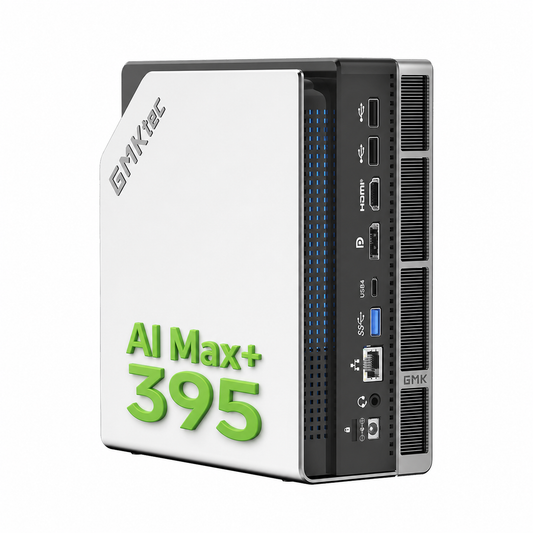
Almost simultaneously, GMKtec’s EVO-X2 achieved local inference of a 235B-parameter model with its 126 TOPS computing power, redefining the meaning of “mini” alongside NVIDIA’s DGX SPARK.
Tracing back more than 50 years — from DEC minicomputers of the 1960s that filled half a room to today’s palm-sized AI devices — the history of the mini PC is, at its core, an ongoing revolution of “compute density compression” and application-scenario transformation.
NVIDIA DGX Spark vs. GMKtec EVO-X2


The First Breakthrough: From Server Rooms to the Desktop (1960s–1970s)
In an era dominated by IBM mainframes, “computers” meant machines occupying dozens of square meters and costing millions of dollars—accessible only to governments and top research institutions.
-
1960: DEC PDP-1 – This minicomputer reduced the physical footprint to a single cabinet and brought the price down to one-tenth of a mainframe, allowing universities and mid-sized enterprises access to computing power.
-
1965: PDP-8 – Widely regarded as the origin of the modern mini PC. Weighed only 50 kg, sold for $18,000, and expanded into industrial control, medical diagnostics, and other fields.
-
1970: PDP-11 – Introduced 16-bit architecture supporting multitasking. DEC captured 70% of the global minicomputer market.
This era marked the beginning of miniaturized computing accessible beyond government labs.
Transformation and Turbulence: The Microprocessor Reshapes the Industry (1970s–1990s)
The Intel 4004 microprocessor (1971) revolutionized computing by integrating 2,300 transistors on a fingernail-sized chip, enabling desktop-sized computers.
-
Altair 8800 and Apple I – Early personal computers powered by microprocessors, priced under one-fifth of traditional minicomputers.
-
IBM PC and compatibles – Sparked the divergence between traditional minicomputers (servers/workstations) and smaller personal computing devices.
-
1998: DEC acquired by Compaq – Marked the end of the cabinet-based minicomputer era.
Early-Stage Exploration: Low-Power Technology Gains Momentum (2000s–2012)
The 21st century brought nanometer-scale semiconductors and low-power processors such as Intel Atom and AMD Geode, paving the way for the modern mini PC.
-
Industrial Applications – Embedded mini-modules for real-time production line processing.
-
Education Sector – Thin-client terminals for cloud-based resource sharing.
Mini PCs remained niche, functioning as “behind-the-scenes workers” with CPUs, GPUs, and memory condensed onto palm-sized motherboards and power consumption under 30W.
Mainstream Breakthrough: Intel NUC Ignites the Consumer Market (2013–2018)
2013: Intel NUC (Next Unit of Computing) brought mini PCs into public view. Compact, versatile, and user-upgradable, it fit seamlessly into office and home scenarios.

-
2014: Ivy Bridge with Thunderbolt ports
-
2015: Skylake 14nm architecture
-
2018: Coffee Lake Core i7 models enabled light gaming and creative workloads
This success inspired Chinese manufacturers like Minisforum and GMKtec to launch NUC-style designs with competitive pricing, expanding the mini PC market.
The Computing Power Revolution: AI Redefines Mini PCs (2019–Present)
Post-2019, AI technology and the rise of Chinese manufacturers propelled mini PCs into a new era:
-
GMKtec EVO-X2 – Desktop AI supercomputer, leveraging 126 TOPS computing power.
-
Apple Mac mini M4 (2024) – Introduced hardware-accelerated ray tracing and multi-display support.
Mini PCs evolved from productivity tools into desktop AI supercomputers, igniting a local AI computing race.
DGX Spark vs. EVO-X2: Specifications and Performance
| Specification | NVIDIA DGX Spark | GMKtec EVO-X2 |
|---|---|---|
| Processor | Grace Blackwell GB10 (20 Cores ARM CPU + Blackwell GPU), FP4 1 PFLOP | Ryzen AI Max+ 395 (16 Cores Zen5 CPU + RDNA3.5 GPU), XDNA 2, 126 TOPS |
| RAM | 128GB LPDDR5X Unified memory (273GB/s) | 128GB LPDDR5X (256GB/s), dynamic video memory up to 96GB |
| Storage | 1TB/4TB SSD | 2TB PCIe 4.0 SSD (expandable to 16TB) |
| Price | 28,917 RMB (4TB) | 14,999 RMB (128GB + 2TB) |
| Power Consumption | 170-240W | 140W peak |
| OS | DGX OS (Linux-based) | Windows 11 + Linux dual system |

Key Differences:
-
Computing Architecture: DGX Spark excels in extreme throughput; EVO-X2 offers versatile multi-tasking and low-latency AI.
-
Price Advantage: EVO-X2 costs ~52% of DGX Spark while maintaining comparable or superior performance.
AI Performance Highlights:
-
Large Model Inference: EVO-X2 achieves faster token generation and lower latency.
-
Multitasking: EVO-X2 can simultaneously run text, image, and video AI workloads.
-
Energy Efficiency: EVO-X2 achieves 126 TOPS at 140W, 87% lower power than DGX Spark.
-
Software Ecosystem: EVO-X2 supports Windows and Linux; DGX Spark is limited to NVIDIA proprietary Linux tools.
Recommended Users:
-
EVO-X2: Local AI developers, creative professionals, small businesses, and individuals seeking cost-effective AI.
-
DGX Spark: Labs or researchers handling ultra-large models (200B+ parameters) with high budgets.
Conclusion: At the Crest of AI Democratization
The GMKtec EVO-X2 demonstrates that high-performance AI computing can be accessible, cost-effective, and versatile, bringing AI desktop supercomputing to a wider audience. Meanwhile, NVIDIA DGX Spark remains a symbol of peak AI performance for specialized research.
Looking ahead, GMKtec plans the EVO-T2, leveraging Intel’s 18A process and achieving 180 TOPS AI computing power, exemplifying 50 years of miniaturization and performance growth.
Today, GMKtec products are sold in over 70 countries, dominating mini PC rankings on Amazon Japan and the US, proving that Chinese manufacturing is shaping the global desktop AI supercomputing market.